×

Places on a mission: toolkit

This toolkit sits alongside our joint paper – Places on a mission: pioneering local statecraft in an era of uncertainty – and case study collection exploring how places are taking a mission-based approach to local government. You can find our definitions for missions and how they are being used by both national and local governments here.

The toolkit has been developed using insights gained from workshops and interviews with senior local government officers who are taking a mission-based approach. We have also drawn on interviews with a small number of policy and academic professionals as well as a review of key literature.

The tools themselves are not intended to be read as a blueprint for “doing missions”. Instead, they provide a set of ideas and prompts which can be used as lenses through which to think about this way of working in your context or place.

While the toolkit is designed primarily for those working in local government (both councils and strategic authorities), it will also be valuable for anyone who is thinking about missions and mission-led ways of working in places: that could include people working in the wider public sector, the VCSE and private sectors and in communities.

The toolkit is organised around five toolsets. The toolsets relate to what, in our paper, we call catalysts: the five ways that we have identified in which missions-led working can be used to unlock solutions to the big, interconnected challenges facing places.
Background reading

There are lots of excellent resources available to support councils and strategic authorities to adopt new ways of working, covering areas including user centred design, test & learn, using innovation tools, and Human Learning Systems. This reading list is not exhaustive but rather is here to signpost to a brilliant range of papers and resources on missions, mission-led ways of working and other purpose-led government tools and methods.

Missions theory and setting missions
Mission-led ways of working
International case studies

Developing a missions mindset

Mission-led working is about more than a collection of practices. Senior leaders have a critical role to play in supporting people and creating the conditions across organisations to cultivate a mindset that supports good missions working. There are several resources which set out what characterises a missions mindset – see background reading for examples.

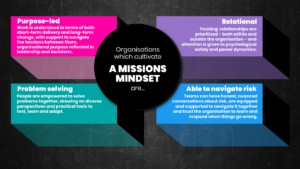
Drawing on these resources and the practical insight senior local government officers shared, we identified four mutually reinforcing areas councils and strategic authorities could focus on to support leaders and teams to develop a missions mindset.

Purpose-led

In a purpose-led organisation, people:

  • Are comfortable thinking about how their work contributes to short- and long-term outcomes.
  • Feel supported in navigating the tensions and trade-offs between delivery pressures and long-term challenges.
  • See organisational purpose reflected in decision making processes and leadership.
Relational

In relational organisations, people:

  • Understand the importance of putting relationships with colleagues, partners, people and communities first in their work, and have the approaches, tools and practices to support this.
  • Understand their role in creating high trust and psychologically safe teams and in building trusting partnerships outside of their teams.
  • Examine and understand their own motivations and connection to their work and are curious to understand the motivations of others.
  • Are conscious of power dynamics and are open to exploring how these can be shifted to grow more equitable and trusting relationships and better outcomes.
Willing and curious to problem-solve

In organisations which are both willing and curious to solve problems, people:

  • Are confident in their expertise and autonomy to solve problems.
  • Understand the value of collective problem solving, bringing in diverse perspectives – outside of organisational and professional silos – and drawing on innovation tools and ways of working to help identify potential solutions.
  • Feel equipped with tools and approaches to explore and understand a problem, test potential solutions, learn about what is and isn’t working, and draw from both successes and failures in ways that are safe and appropriate to their areas of work.
Confident navigating risk

In organisations that are confident navigating risk, people:

  • Are able to identify and have nuanced discussion about both the risks of action and inaction in their work.
  • Feel they have the tools and approaches, and relationships across the organisation and system, to navigate risks and ensure risk aversion does not become a blocker to doing the right thing.
  • Feel confident in how the organisation learns when things go wrong and in its ability to sustain a nuanced view of risk.

Four areas to support leaders and teams to develop a missions mindset

Delivering through mission sprints

It is challenging to nurture and grow new capacities and ways of working whilst simultaneously navigating the pressures of day-to-day responsibilities. At the same time, it is both vital and difficult to demonstrate success and build momentum around missions and mission-led ways of working.

A sprint methodology can help in both regards.

To deliver the sprint, build a team which...
  • is multidisciplinary, with members drawn from across the council or strategic authority. It may also include partners from outside.
  • is protected from “business as usual” activity, with dedicated time and resources.
  • has a senior champion to provide cover for the work and help unblock problems that get in the way.
  • has a timebound problem to solve or a challenge to make progress on, which is connected to a mission.
  • is guided by a missions mindset in how it operates.
  • is supported to use a range of practices and approaches suited to the problem (e.g. agile, test & learn, innovation tools).
Working in this way enables...
  • rapid progress to be made on a particular mission-based challenge or problem.
  • the team to feel they have developed their experience of applying a missions mindset in practice and deepened their skills around mission-led ways of working.
  • learning to be fed back into the organisation (and to system partners) to demonstrate value, show how common challenges or blockers could be overcome and to spot potential to grow these ways of working further.

Developing impactful missions

Missions are context specific: in every place there will be competing and interrelated challenges and priorities. This makes it difficult for councils, strategic authorities and system partners to identify the types of problems which are best suited to a missions approach.

The following set of questions can support councils and strategic authorities to work with system partners to scope and build consensus on impactful missions. There are also many excellent resources which set out what makes a good mission – see background reading for examples.

Data and insight
  • What are the issues that really matter in our place?
  • Do we have diverse perspectives on this? Who haven’t we heard from?
  • How could data be used to build a richer picture of the challenges and opportunities in our place?
  • How are we thinking about and tracking growth and progress beyond traditional economic metrics?
Potential for impact
  • Where can we have the most impact in our place?
  • Are the challenges ambitious and aimed at addressing root causes?
  • Would shifting the dial on these challenges benefit from a different way of working (i.e. they are unlikely to be solved by “business as usual” activity)?
Coalition building
  • Is there energy across the system to work on these missions?
  • Is there political buy-in and alignment with political priorities (e.g. mayoral manifestos or Local Growth Plans)?
  • Is there buy-in from senior leaders across the system?
  • Will these missions help to build momentum around positive work already happening in the system and help solve the blockers which get in the way?
  • Is there strategic alignment between council and strategic authority missions? Do these missions connect to government priorities?

Building confidence in missions

Councils and strategic authorities often lead efforts to convene partners around missions. But for them to be impactful, they need to be something that partners across a place are committed to working on and sticking at for the long-term – weathering short-term changes and political cycles.

For this to happen, partners need to grow their confidence that it is worth investing in working on and developing capabilities around missions.

A core part of building system-wide confidence is showing successes and progress.

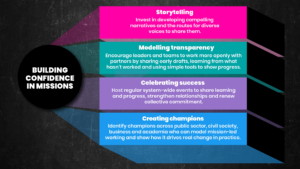
Here are four practical ways to build confidence in missions and grow the coalition of partners working in service of missions:

Storytelling
  • Invest time in building both the narrative around missions and the routes for storytelling about the impact of working in this way. Consider how different voices can own and tell the story of the work.
Working in the open
  • Encourage leaders and teams to model transparent ways of working with partners. This might include sharing messier early versions of work, being more open about learning and what hasn’t always gone well, and practical approaches like weeknotes to share what your team is doing on a regular basis.
Celebrating success
  • Convene annual (or more frequent) events, which bring system partners together and involve sharing stories of progress and learning, developing connections between people and organisations, and building momentum and practical action for the year ahead. These events can also help to restate collective commitment to the missions and mission-led ways of working.
Creating champions
  • Identify people from across the system – other public sector partners, civil society, businesses and academia – who are energised by this way of working and can share what it means in the context of their work, and how it is helping them to get things done.

FOUR WAYS TO BUILD CONFIDENCE IN MISSIONS

Toolset three: system mobilisation

Where missions can take you:

Missions direct energy towards galvanising people and organisations, beyond local government, to act – growing a system capable of responding to complex challenges.

Tools to help you get there:

Enabling partners to take action →

Enabling partners to take action

Missions are a route for councils and strategic authorities to understand and operationalise their role as system stewards and convenors. This means creating the conditions for other people and organisations to act in service of missions both in partnership and individually.

We have developed a set of prompts to think about how your council or strategic authority can work with or enable a range of partners to take action on missions.

Other public sector organisations
  • Convene and build a movement to align action around missions and mission-led ways of working.
  • Share the successes and insights of other organisations through communications channels and platforms.
  • Work together to pool data and insights to understand critical local and regional priorities and the potential routes to having impact on them.
  • Identify opportunities to pool funding, attract investment and test new ways of working together in service of local or regional missions.
  • Support the growth of new ways of working and innovative practice (e.g. spot opportunities to move first and then share learning on system conditions which made this work possible, for eaxmple, approach to managing risk).
VCSE organisations
  • Look for opportunities to align grant making approaches, procurement and commissioning with missions.
  • Support the growth of mission-led ways of working across the sector (e.g. through commissioning process, support for sector capability building, and development of tools, platforms or other approaches that can be shared across the sector).
  • Align VCSE strategy with missions and mission-led behaviours.
  • Identify opportunities for meaningful, participation from VCSEs in mission governance and decision making (e.g. on mission boards).
Communities
  • Use participatory and deliberative forums as a route for communities to shape missions, develop ideas to take action on missions and contribute to understanding impact.
  • Support communities to take action on mission areas (e.g. through approaches like community grants and participatory budgeting).
  • Identify or create forums to be held accountable on mission progress or to adjust mission direction in line with community need.
SMEs
  • Look for opportunities to align procurement and commissioning with missions.
  • Explore regulatory levers to support action on missions.
  • Model market shaping practice, and de-risk investment in innovation opportunities that creates the space for other organisations to crowd in.
Large businesses and major employers
  • Look for opportunities to align procurement and commissioning with mission targets.
  • Develop industry and government alignment on the benefits of working in partnership in service of local or regional missions – particularly in drawing connections to local and regional economic development.
  • Explore regulatory levers to support action on missions.
  • Model market shaping practice, and de-risk investment in innovation opportunities that creates the space for other organisations to crowd in.
Universities and research organisations
  • Look for opportunities to build research partnerships and leverage funding to support mission outcomes.
  • Build partnerships to support development of long-term outcomes measures and evaluation frameworks.
  • Look for opportunities to develop government, university and industry partnerships which could contribute to making progress on local and regional missions.
Funders
  • Convene funders to explore opportunities to deepen shared impact through alignment around missions and through adoption of mission-led ways of working.
  • Look for opportunities to co-fund initiatives in service of local or regional missions.


Toolset four: community power

Where missions can take you:

Missions shift how local government works with people and communities through creating mechanisms for deep listening and by growing a broad movement where they have confidence and a stake in solutions.

Tools to help you get there:

Deepening collaboration with communities →

Deepening collaboration with communities

Missions help councils and strategic authorities to build unifying narratives that can shift how government works with people and communities. This is increasingly vital in efforts to deepen trust in institutions, improve public services and deliver better social, economic and environmental outcomes.

We have developed a set of prompts for councils and strategic authorities to reflect on how to deepen and grow ways to work with people and communities through a missions framework.

Using participatory and deliberative approaches
  • What deliberative and participatory tools could you use to meaningfully involve communities in discussing the root causes of big local or regional challenges and priority areas for missions?
  • Do you have informal participatory forums which could help nurture community action on problems connected to missions?
  • How are you sharing knowledge and building mission capabilities within community groups, so they are not just informing but actively shaping work on missions?
  • How can you use participatory and deliberative approaches to involve communities in ongoing planning around missions and in understanding their impact?
  • How can diverse community representation be built into governance structures supporting the delivery of missions? Are there creative structures or formats you could test to meaningfully involve communities in mission governance?
Growing relational practice
  • How do narratives about building more relational and preventative public services link to narratives about the long-term change you are trying to build through missions?
  • What examples do you have already which demonstrate the impact of adopting a missions mindset – with relational practice at its core – to problem solve and deliver better outcomes? How can you amplify and share these successes through existing networks and forums?
  • Where could there be future opportunities to demonstrate the impact of adopting a missions mindset through the lens of relational practice?
Investing in community action
  • Could existing or new funding for communities be aligned with missions?
  • How can you use events, storytelling and the celebration of successes to build energy and momentum around missions and invite communities to act?
  • How can you use storytelling to help missions feel tangible to communities and to demonstrate where it has been possible to start to shift the dial on big challenges?

Toolset five: impact in uncertainty

Where missions can take you:

Missions support councils and strategic authorities to critically assess how to become more impactful institutions better suited to operating in complex and uncertain times.

Tools to help you get there:

Shifting towards impact →

Shifting towards impact

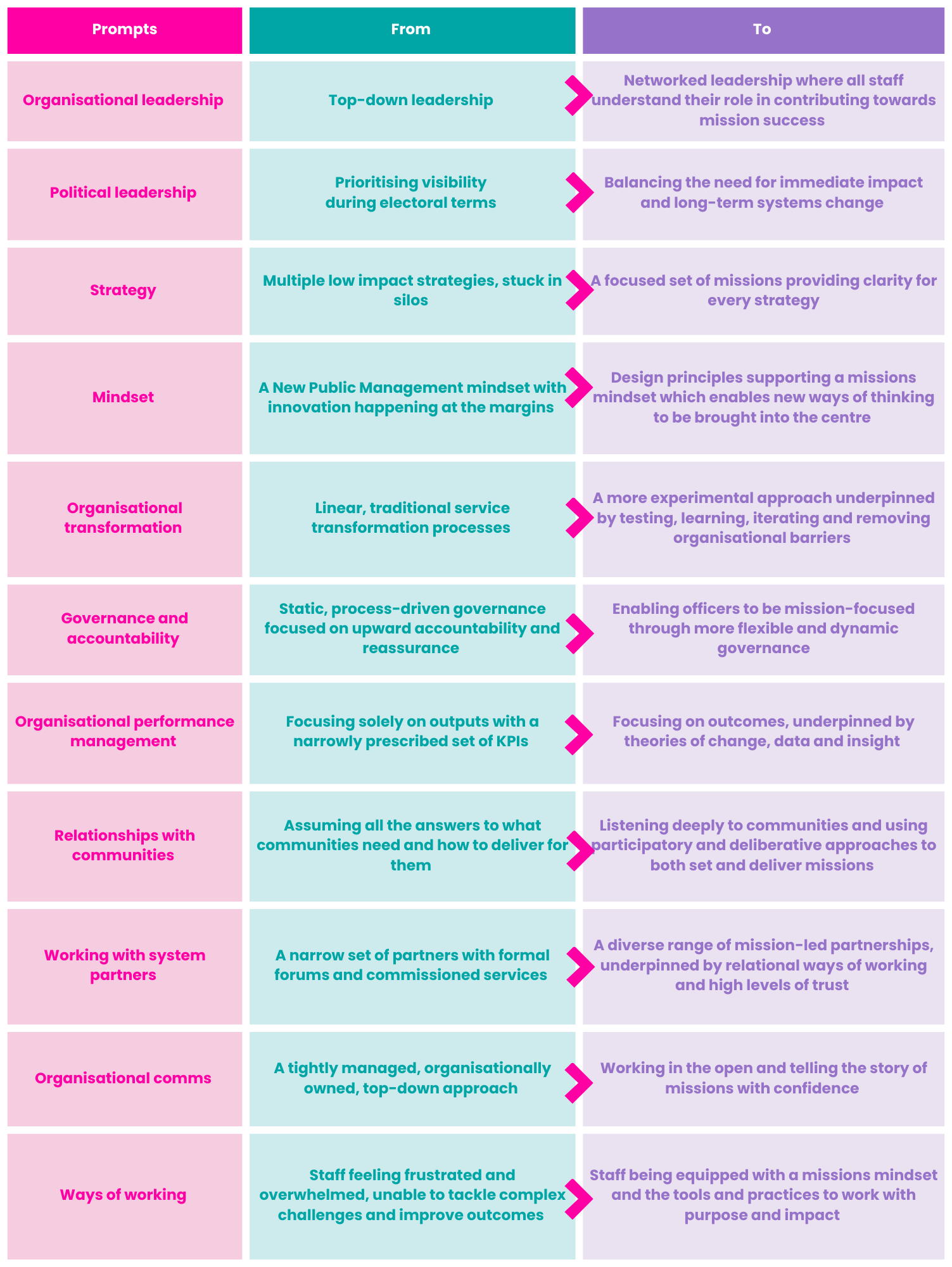
This table provides a set of prompts for councils and strategic authorities to consider how using missions as an organising principle can help to shift towards the organisational design, capabilities, culture and ways of working needed to have impact in uncertain times.

The table also recognises that becoming a mission-led organisation is not a single change, but a shift that plays out across different organisational features. Action may be needed at different scales, and at different moments, as an organisation moves along its journey to becoming more mission-led.