Neighbourhoods in practice: Camden

Across local government, there is growing interest in working at the neighbourhood scale as a way of delivering more relational, preventative and community-powered public services.
In recent months, we’ve been sharing how councils in our network, and their partners, are putting neighbourhood approaches into practice. Through a series of case studies and conversations, we’ve been examining different models, the challenges they face and the lessons they offer for others.
Our third case study takes us to Camden, where the council is rethinking how it works with the people and places it serves.
In this Q&A, Sophie Taylor, Senior Design Researcher and Freya Abbott, Senior Policy and Projects Officer at Camden Council unpack how devolving services to shared local geographies helps break the “service pressure loop” — where statutory pressure pushes staff into reactive, siloed working that fails residents. Drawing on their test and learn approach in East Camden, they share a model built on relational spaces and reflective practice sessions, and what they’ve learned so far.
Neighbourhood working in Camden: at a glance
- Services that support residents with more complex needs working in smaller geographies.
- Building trusted relationships and becoming a genuine ‘team of teams’ in a local area: drawing on the whole system to support the whole person.
- The core problem is “the service pressure loop”: local authorities have to do more with less while still being compelled to prioritise statutory duties, inspections and performance targets.
- To bring together a range of policy agendas and intent around neighbourhood working
- To spread learning about what neighbourhood integration of services for those with complex needs could look like in practice
- Striking a balance between anticipating new leadership direction, central government guidance and additional resources versus leading from the neighbourhood level through local test-and-learn.
- Keeping up momentum, coordinating all activity around a shared purpose, and continuously securing buy-in.
What’s your approach to working with communities and your focus on neighbourhoods?
The ‘neighbourhoods’ agenda has a long history in Camden. It is a complex policy programme encompassing multiple overlapping ambitions, including joined up, local service delivery (an expectation set by residents in our 2020 Health and Care Citizens Assembly), a commitment to relational and preventative practice, addressing population health needs through place-based approaches, activating local assets like unused buildings and working in closer partnership with the voluntary and community sector.
Our broad vision is that we want people in Camden to live in supportive neighbourhoods where community flourishes: where there are strong social bonds, people help each other out, and there are things to get involved in that support health and wellbeing. When people do need to access care or support to fulfil their potential, it should be seamlessly accessible within their neighbourhood, and relational and strengths-based, keeping them well before crisis hits.
It’s a big ask. ‘Neighbourhoods’ can at once seem like a panacea for all our hopes and fears around future public sector reform, whilst also appearing to seasoned frontline practitioners like ‘common sense’ or ‘the way we used to do things’ (e.g. in the 1980s it was common to see ‘patch-based’ social work). The simplicity of the term ‘neighbourhoods’ obscures how complex it is to achieve.
The first principle of neighbourhood working in Camden is having services who support residents with more complex needs working in smaller geographies. Camden was one of the recipients of Family Hubs funding in 2021 – these services were already working on a locality-based model. In 2023, our Adult Social Care Safeguarding and Support Services, and NHS Central North West London Community Health teams agreed to devolve their services to the same neighbourhood geographies (North, South, Central, West, East). Key Housing and Community Services (including Neighbourhood Housing, Repairs, Community Safety) also devolved to these geographies.
But smaller geographies are only the first step: ‘neighbourhoods’ are really about what more collaborative ways of working can enable for services.
Working on local patches (drawing on infrastructure that helps them collaborate meaningfully) allows professionals to get to know each other; building a trusted network from whom they can draw on for support with complex casework, as well as getting to know and working differently with local assets and people in the community.
As Strategy Officers supporting ‘test and learns’ in the East neighbourhood, we’ve seen firsthand how this can be enabled. We’ve helped public service teams and voluntary and community groups to build trusted relationships and become a genuine ‘team of teams’ in a local area: drawing on the whole system to support the whole person.
There are lots of examples of this across other neighbourhoods in Camden that we are discovering and connecting into: e.g. the co-location of voluntary sector partners in Holborn Library. Talented practitioners and service managers see the value in this way of working and are innovating across the system. Our task now is to join this all up into a coherent approach that we can scale and monitor the success of.
What’s the core problem you’re trying to solve?
The core problem we’ve come to focus on in our approach to the neighbourhoods’ work, and the one we believe matters most to our staff and residents, is what we call the ‘service pressure loop’.
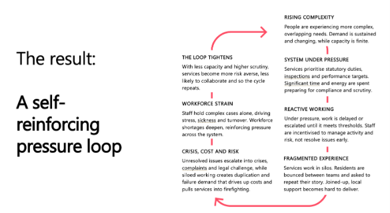
Our welfare state was not designed to meet the levels of complexity in people’s needs that we see today. With a national rising cost of living, increased isolation following Covid and tightening resources, local authorities have to do more with less, in creative new ways.
Yet still, our services are compelled to prioritise statutory duties, inspections and performance targets. Significant time and energy are spent preparing for compliance and scrutiny.
Under these pressures, staff work reactively – they are incentivised to manage activity and risk, not resolve issues early. Services manage these pressures by working in silo, whilst residents are bounced between teams and asked to repeat their story. Unresolved issues escalate into crisis complaints and legal challenges, while siloed working creates duplication and failure demand that drives up costs.
Staff from all services hold more complex cases alone, driving stress, sickness and turnover. Workforce shortages increase, reinforcing pressure across the system. With less capacity and higher scrutiny, services become more risk averse and less likely to collaborate – and so the cycle continues.
The theory is that joining up and working relationally and proactively in a neighbourhood reduces failure demand; the support offered to residents is more likely to meet their needs the first time, as professionals respond creatively and draw on a diversity of trusted local support offers, rather than residents having the experience of being ‘funnelled through’ siloed processes and procedures that only address part of their problem.
This is hard to evidence unequivocally, especially from time limited ‘test and learns’, though we’ve collected many case studies that strongly point in this direction. We’ve also gathered evidence of this way of working facilitating large cost savings across services like temporary accommodation and repairs.
In addition, our staff survey of our East Integrated (health and care) Neighbourhood Team from 2024-25 showed improvement particular in staff’s perception that patients were receiving care from the system they need, that patients had a joined experience of support across different services, that they felt part of a multidisciplinary team in supporting and caring for local residents, and that they had trust in the other professionals they work with.
As our public health team have reflected, when doing a big piece of systems change work – it is usually visible first in the conditions that enable the system to work differently (i.e. staff relationships, behaviours, ways -of-working). Therefore staff experience (e.g. measured through a survey) is likely to be a more sensitive indicator than anything available in administrative data (see more reflections on evaluation here).
What are the major opportunities for councils in using ‘neighbourhoods’ as an organising principle?
Alongside the broader vision, we believe the big prize of neighbourhood working is to make the system more responsive to the needs of residents and the local insight of frontline staff working in a neighbourhood. Neighbourhoods should feed frontline insight up the system, so strategic leaders can also take action earlier.
As neighbourhood ‘team of teams’ take shape and realise their shared identity, we can spot patterns, pressure points and unmet needs earlier than through formal reporting alone. This creates a live feedback loop where frontline experience informs policy, commissioning and investment decisions in real time.
Hand in hand with Camden’s central data function, this helps the council act earlier and learn faster, supporting insight-driven prioritisation. For example, the East Housing and Community team is working with central Housing Policy and Public Health teams to respond to staff concerns about supporting residents affected by suicide loss.
East health and care teams have also chosen residents with hoarding behaviour as their priority cohort for a new service delivery pathway, thanks to analysis from reflective practice Working Together Sessions that showed these residents made up a significant proportion of the cases staff were bringing to these spaces for multidisciplinary input. NHS primary care systems don’t code for hoarding: there would have been no way of appreciating the extent of the impact of this on the local system without neighbourhood working.
What are the challenges of working this way?
Part of the challenge of neighbourhoods working across Camden is striking a balance between anticipating new leadership direction, central government guidance and additional resources, versus leading from the neighbourhood level; getting on with testing and learning locally within our existing resources and means.
For example, Camden Family Hubs’ recent history has been defined by clear ‘top down’ minimum service expectations and funding from the Department for Education (though this guidance built on the success of Sure Start Centres, which were initially a locally designed, ‘bottom up’ initiative).
In contrast, in our Adults and Health Directorate, the work has partly been characterised by experimenting through ‘test and learn’, whilst anticipating further clarity in national guidance (though the recent neighbourhood health framework remains permissive). An evidence review in 2024 showed clearly that ‘starting small’ was an effective way to think about neighbourhood integration; our ‘test and learn’ through the East integrated health and care team in Kentish Town has built strong relationships and new ways of working through small experiments.
A model of Housing and Community services neighbourhood integration has also been developed through ‘test and learn’ since Summer 2023 in the East. This has been based on local action, with no current mandated national policy direction.
Although the integration environment can appear more mature and centrally structured in the children and families’ space, National Reforms and guidance around creating an ‘All-Age Offer’ is requiring local teams to also experiment with joining up locally in new ways. Family Hub Locality Leads are exploring how to bring in Family Help teams effectively and closer collaboration with Youth Hubs for adolescents, for example through the shared use of buildings in the West. Family Help teams have also been collaborating in Housing and Communities and Health and Care multidisciplinary team meetings within the East neighborhood, providing whole family support.
Keeping up momentum, coordinating all this activity around a shared purpose, and continuously securing buy-in from leaders and frontline practitioners across the system (especially when turnover in frontline health and care roles is high), is no easy feat.
How could systems be changed to enable ‘neighbourhood working’ to be more easily integrated into council delivery?
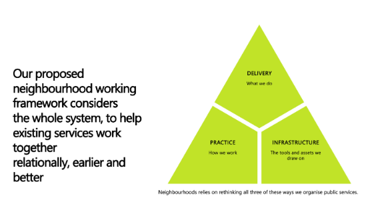
Based on our learning from ‘test and learns’ in East Camden, we’ve started to conceptualise neighbourhood working through the lens of ‘infrastructure, practice, delivery’. This is a framework we’ve developed to encompass the various theories of change about how we can use our existing resources effectively to integrate and shift the system towards achieving the broad aims of the neighbourhoods’ agenda. Our conception of neighbourhood working is not as a new service, it is a way of bringing existing teams together.
We want to use this framework to understand and strengthen different types of infrastructure, practice and delivery in each neighbourhood in Camden – drawing on our diverse assets and already innovative ways of working across the system. We have a ‘version 1’ operating model, highlighting key bits of infrastructure we want to see in place in each neighbourhood, which has helped to distill the ways of working from our test and learns into a model that can be replicated across the whole of Camden.
What is the neighbourhood operating model you’ve developed?
High quality and visible infrastructure is crucial for thinking about integration because it enables join up across the system at different points in different ways. It enables us to think about integration as a system-wide intervention, rather than as delivered through another new service or ‘silo’.
‘Relational Infrastructure’ has been the focus of the work in the East; creating purposeful shared spaces through which to approach casework in different ways, and reducing barriers to effective, holistic collaboration across services (e.g. the shared health and care duty desk, reflective Working Together Sessions, Learning and Sharing Sessions, a Housing Clinic, our Hoarding Community of Practice). These spaces have been designed in the East response to staff needs, and are well attended from across local services. There is now strong demand from frontline staff to scale these across other neighbourhoods.
Digital and asset management workstreams have also been commissioned to ensure staff across the council, NHS and voluntary sector enjoy strong digital connectivity and can use buildings across neighborhoods for in-person meetings, co-location and resident-facing activities.
We also see relational practice as a key aspect of our neighbourhoods framework. We want all professionals to work in a relational, creative, and holistic way with residents, solving problems alongside them and navigating them through a local system of support.
There are lots of roles in the local system who are specifically empowered with the capacity or autonomy to work in this way – for example, Family Workers, CNWL complex care nurses, Neighbourhood Housing Officers, NHS Social Prescribers, ASC Outreach workers or Mental Health VCS Support Workers.
However, not all have the right training or support to do this confidently; our ‘Adult Early Help’ pilot surfaced the need for guardrails, flexible frameworks and boundaries for practitioners through reflective practice and learning environments to guide their work. Another key learning from this pilot was that this intensive, relational support can only work when it is plugged into a joined up local system – pointing to the need for strong infrastructure. As one pilot worker said as part of the evaluation “most challenges have come from internal collaboration with other teams in the council, from long waiting times for simple responses to lack of suitable services for support.”
New types of delivery models draw on practice and infrastructure to ensure particular outcomes around preventative working are achieved. Our Family Hubs pregnancy grant project is an example of an exciting delivery model that draws on neighbourhoods infrastructure and relational practice. Data is used to proactively identify low-income pregnant women to invite them to receive a grant of £500, as well as support from a Family Hubs Navigator (a role empowered to work relationally) who can connect them to existing local service offers.
We have been also testing out new delivery models with our VCS partners in the East neighbourhood, experimenting with community action days to support those experiencing loneliness and isolation in unused local buildings (Welcome In, Kentish Town).
Interested in learning more about neighbourhood working, read Turning neighbourhood momentum into lasting public service reform.
Neighbourhoods are having a moment. Our recent blog explores why they matter and what that means for the future of public service reform.
 Join our mailing list