How We Did It: Building engagement through co-designed collaborative training with communities and staff

Building trust and lasting relationships between councils and communities across a place isn’t easy.
It starts with genuine engagement—bringing staff and local stakeholders together to listen, learn, and co-produce solutions.
We invited Andre Johnsen to discuss Westminster Council’s Change Maker programme, an initiative designed to tackle power imbalances and build lasting relationships. Here is how they developed the programme, tailored it to different groups, and the impact it has made so far.
Interview highlights
On why we developed the programme
Following an administration change in 2022, our priorities shifted toward new ways of working.
This gave an opportunity to look at some challenges around things like duplication across services and a culture gap in between a really competent and talented workforce and the lived experiences of communities in a central London borough.
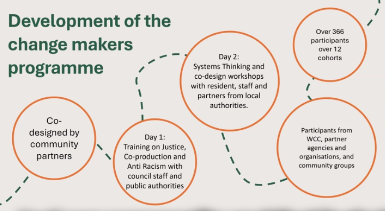
We needed to develop opportunities for officers to deepen their connection with local communities and understand those lived experiences. We also wanted to equip them with the basic tools needed to design services for the future. To do this, we co-produced the Change Maker programme, creating a direct pathway for relationships between communities and officers. Over the last two years, we’ve delivered 12 pilots.
On trial and error: Finding the right format
Our original “blue sky” vision was a 10-day programme. We quickly realised that wasn’t scalable—we just couldn’t get people in a room for that long. The final, successful iteration ran over two days.
We targeted three groups: council officers, statutory partners, and community representatives living in the borough.
We learned early on that you can’t just bring everyone together immediately. Officers and partners needed a safe space first to understand the real historic and systemic barriers people in the borough face.
Consequently, Day One focuses on officers and public authority partners, training on justice, co-production and anti-racism. This preparation ensures they are ready to contribute meaningfully on Day Two, where community members join for co-design.
A major part of Day Two is navigating the complexities of council systems. We focus on creating a “baseline dictionary”—getting everyone to speak the same language—so we have a fair starting point for collaboration.
While this creates a short window for actual co-design, we always emphasise that the Change Maker programme is just the starting line. It’s about building trust and shared understanding necessary to take work forward.
On how it works
We offered this as a free internal programme to services across the council, and the uptake has been diverse. Some cohorts focused on broad themes like climate change, while others were specific to a place.
For example, one cohort focused on the redevelopment of a public market square and a venue closure. By leaning into different voices through this programme, they identified a solution that led to a new space being found for a temporary community hub.
On measuring impact
Evaluating a two-year cultural shift is tricky. It is hard to pinpoint exactly when or why a change happened when there are so many external factors. However, the feedback has been useful.
Residents have reported a renewed sense of trust and felt genuinely involved. Officers have had their thinking challenged regarding how they engage with the public. Interestingly, new council officers found the programme particularly helpful for making faster community connections and integrating into different circles.
Much of what we’ve learned has now been embedded into the “Westminster Way,” our corporate strategy for culture and working habits.
On focusing on access and resources
From the start, we were serious about accessibility. This meant removing physical barriers and, crucially, remunerating residents for their time whilst taking part in the programme. We also stripped the curriculum of jargon, ensuring everything was in Plain English. This allowed us to engage people from under-represented groups who might not usually show up.
Finally, we had to be realistic about the resources required. While the programme doesn’t require a large additional budget, it is labour intensive. For every two days of delivery, it takes about six days of officer time to coordinate and support the participants. Understanding that this time is the investment is key to making it work.
Photo by Claudio Schwarz on Unsplash
 Join our mailing list