Neighbourhoods in practice: Stoke-on-Trent

Across local government, there is growing interest in neighbourhood working as a way of delivering more relational, preventative and community-powered public services.
Over the coming months, we will be sharing how councils in our network, and their partners, are putting neighbourhood approaches into practice. Through a series of case studies and conversations, we’ll examine different models, the challenges they face and the lessons they offer for others.
Our first case study takes us to Stoke-on-Trent, where a focus on strengthening communities is helping reshape relationships between residents, public services and local partners.
In this Q&A, Vicki Gwynne, Communities Programme Manager at Stoke-on-Trent Council, explains how a neighbourhoods approach is reshaping their public services. From shifting the system towards prevention and empowering communities, to reducing long-term demand on public services, local people and place-based assets are at the core of how they’re rethinking service design.
Neighbourhood working in Stoke-on-Trent: at a glance
- Place-based working which recognises that communities know best what is needed for them to thrive.
- Working with residents, rather than for them — recognising that communities already possess the strengths, knowledge, and relationships needed to drive sustainable change.
- Strengthen social connection and reduce isolation, increase community participation, improve access to early help at local level.
- Ensure residents have a direct influence on decisions that affect them.
- Relationship-based change takes time and systems focused on outputs and short funding cycles can find this challenging.
- Council services are often structured around departments rather than places — leading to siloed decision-making, duplicated engagement, and long waits for responses.
What’s your approach to working with communities and your focus on neighbourhoods?
Our approach in Stoke‑on‑Trent is centred on the Strengthening Communities Project – place-based working which recognises that communities know best what is needed for them to thrive. The approach prioritises early engagement, building trust, and working with residents, rather than for them. We recognise that our communities already possess the strengths, knowledge, and relationships needed to drive sustainable change in their neighbourhoods and demonstrate the value of hyper‑local working.
For many years, community work in Stoke‑on‑Trent has been shaped by:
- Persistent inequalities across neighbourhoods.
- Variations in health outcomes, life expectancy, and wellbeing indicators.
- Community resilience shown during COVID‑19, which highlighted the power of neighbourhood networks.
These factors led to a renewed focus on neighbourhood‑level delivery where local people and place-based assets are at the core of service design and has been the catalyst for creating our ‘City Alliance’, a mutual agreement between the city council and our voluntary sector.
What services have you been delivering in your neighbourhoods for the past few years?
We have been delivering Community Lounges, where local services provide advice and residents can connect socially; Family Hubs, providing trusted spaces for families to access information and services; and One Stoke project, a partnership across the city to build community cohesion.
These projects started to build trust within neighbourhoods, enabled access to services for local residents, but have not focused on community development or the people.
Our current community development approach integrates Asset-Based Community Development, local knowledge, and a culture of shared responsibility; mapping community talent, skills, and informal networks, supporting resident‑led activity, community‑led work, and building local leadership capacity.
Through this combined neighbourhood‑based model, we aim to strengthen social connection and reduce isolation, increase community participation, improve access to early help at local level, and ensure residents have a direct influence on decisions that affect them.
What are the major opportunities for councils in using ‘neighbourhoods’ as an organising principle?
Using neighbourhoods as an organising principle (place based) creates powerful opportunities for people in Stoke-on-Trent, shifting the system towards prevention, empowering communities, and reducing long‑term demand on public services:
- More responsive, targeted services – When we understand a neighbourhood’s assets and unique identity, delivery becomes more focused and effective.
- Stronger relationships and trust – Trusted relationships make it more likely that residents seek support early and engage in co‑production.
- Community‑led prevention – Unlocking community led initiatives, volunteer‑led activity, peer support networks, and local leadership.
- Better alignment of partners – Neighbourhood working encourages strong cross‑sector collaboration including health, police, VCSE, housing, schools, and faith groups.
- Reinforcing place identity and pride – When decision‑making, investment, and delivery happen locally, it strengthens community identity, encourages stewardship of local spaces, and fosters civic pride.
- Efficiency –Resource sharing and place-based targets can bring more efficient working for public services and spending.

What are the challenges of working this way?
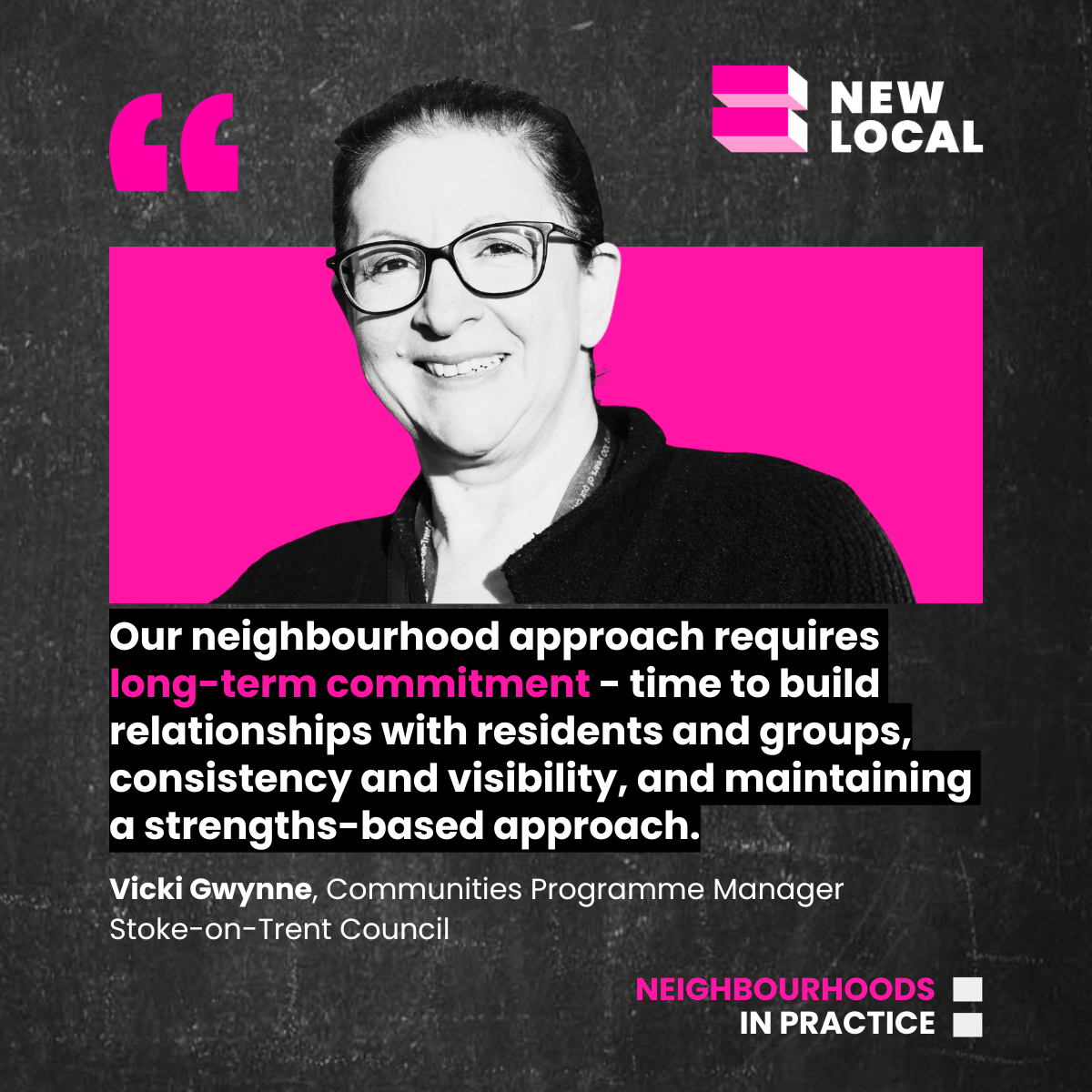
Our neighbourhood approach requires long term commitment – time to build relationships with residents and groups, consistency and visibility, and maintaining a strengths-based approach. Relationship-based change takes time and systems focused on outputs and short funding cycles can find this challenging.
Stoke-on-Trent is diverse, with distinct histories in each town and estate. A one‑size‑fits‑all model doesn’t work, so customisation is essential but resource‑intensive in order to manage and maintain the different neighbourhood identities.
Council services are often structured around departments rather than places. This can lead to siloed decision-making, duplicated engagement, and long waits for responses. Additionally, budget pressures within the council can cause stops/starts that undermine trust.
Neighbourhood‑level data is often incomplete as formal data systems don’t always align to the neighbourhood boundaries that communities recognise. The only way to build a clear picture of the neighbourhood is to collect stories, history, and narratives from local people to use alongside formal data.
How could systems be changed to enable ‘neighbourhood working’ to be more easily integrated into council delivery?
To embed neighbourhood working effectively, system changes should move to place‑based structures, where council teams are aligned geographically rather than by department, establishing locality teams and reducing duplication. Councils need to recognise the importance and usefulness of neighbourhood working and community development, and invest in relationship-based practice – Community Connectors, Development Workers, Engagement Leads etc. Having consistency and visibility in neighbourhoods is essential to building trust.
Equally important is to strengthen cross‑sector governance and help the shift from prescriptive contracts, similar to our local City Alliance. This model helps guide local priorities and share responsibility between council, VCSE, health, and community partners, as well as help to create flexible commissioning and funding models that work for all size and type of organisations, with outcomes-based targets, enabling communities to drive innovation.
Interested in learning more about neighbourhood working, read Turning neighbourhood momentum into lasting public service reform.
 Join our mailing list