Women’s safety and wellbeing in Islington: creative research with UCL
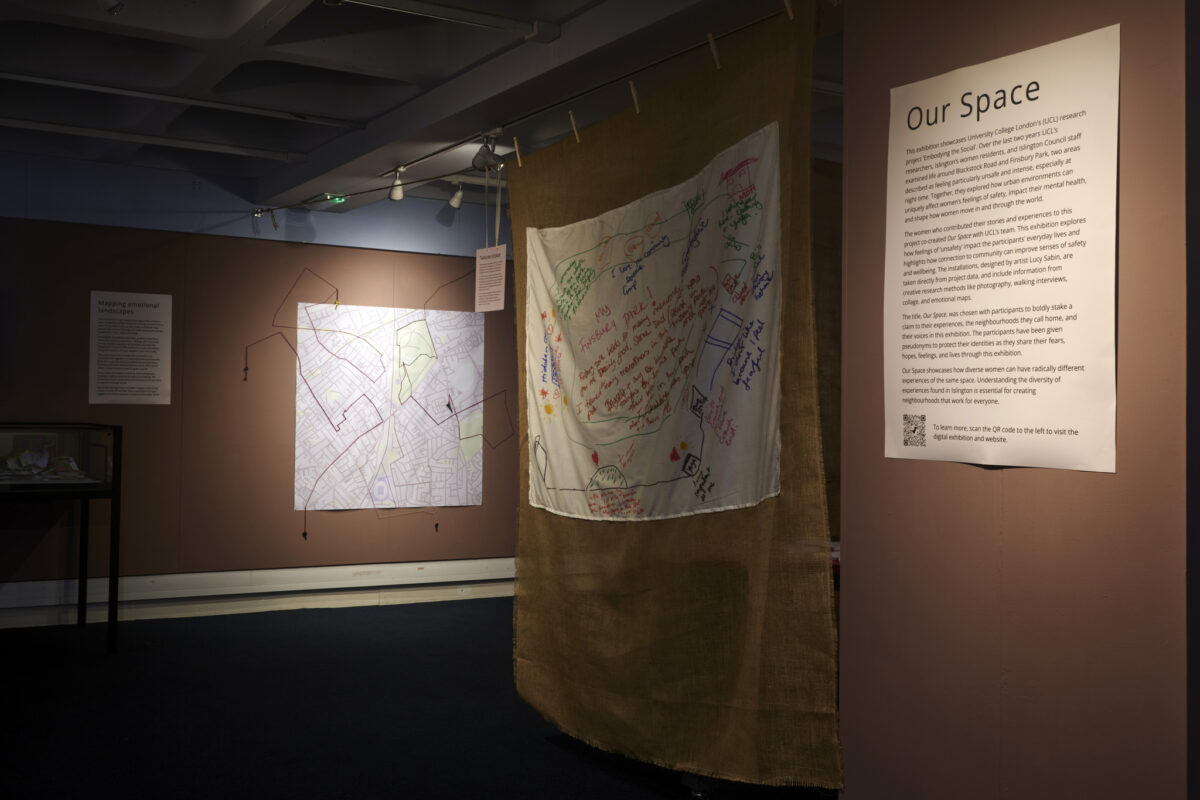
In this guest blog, the team behind Our Space exhibition reflect on how an agreement between UCL and Islington Council grew into a partnership with local women to examine everyday safety in Finsbury Park. They explore how creative research can travel from the street to the gallery and on to practical change on the ground.
Over the last two years, researchers from University College London (UCL) collaborated with Islington Council and local women residents to examine life around Blackstock Road and Finsbury Park, an area characterised by higher rates of Violence Against Women and Girls (VAWG). Research by UCL has found that many women who live and work in the area experience these areas as particularly unsafe and intense, especially at night.
How it all started
The research collaboration with Islington Council follows a Memorandum of Understanding (MOU) with UCL established in 2023. Professor Sahra Gibbon in UCL Anthropology and Professor James Kirkbride in Psychiatry partnered with Islington Council to develop the multi-method project ‘Embodying the Social.’ This project examines how women’s experiences of urban violence impacts their mental health and wellbeing at both an individual and population level.
A total of 30 local women participated in the project’s walking interviews and emotional mapping exercises, using images and hand drawn maps to express their feelings about the area they lived or worked in. These methods highlighted how an individual’s experience of walking certain routes through their neighbourhood has multiple emotional dimensions, ranging from a sense of community connectedness to heightened vigilance or anxiety. Seven women participated in a collage workshop and Photovoice exercises, creating collages and taking photos around their neighbourhood to document and narrate their everyday experiences. Fieldwork was also carried out by Rosie Mathers and Alice McAlpine-Riddell from UCL Anthropology.
Our Space: the exhibition
One prominent outcome of the collaboration between UCL and Islington is the co-produced, community exhibition Our Space, which appeared at Islington Museum between May and August 2026. Our Space took visitors on a journey through women’s everyday experiences, exploring how situations, locations, and encounters heighten feelings of “unsafety” or connectedness in their neighbourhoods. It featured large-scale displays of participant photography, hand-drawn maps, and audio-recorded stories. These materials were arranged by artist Lucy Sabin and co-curated by Islington Museum’s Sarah Guzman Bijl.
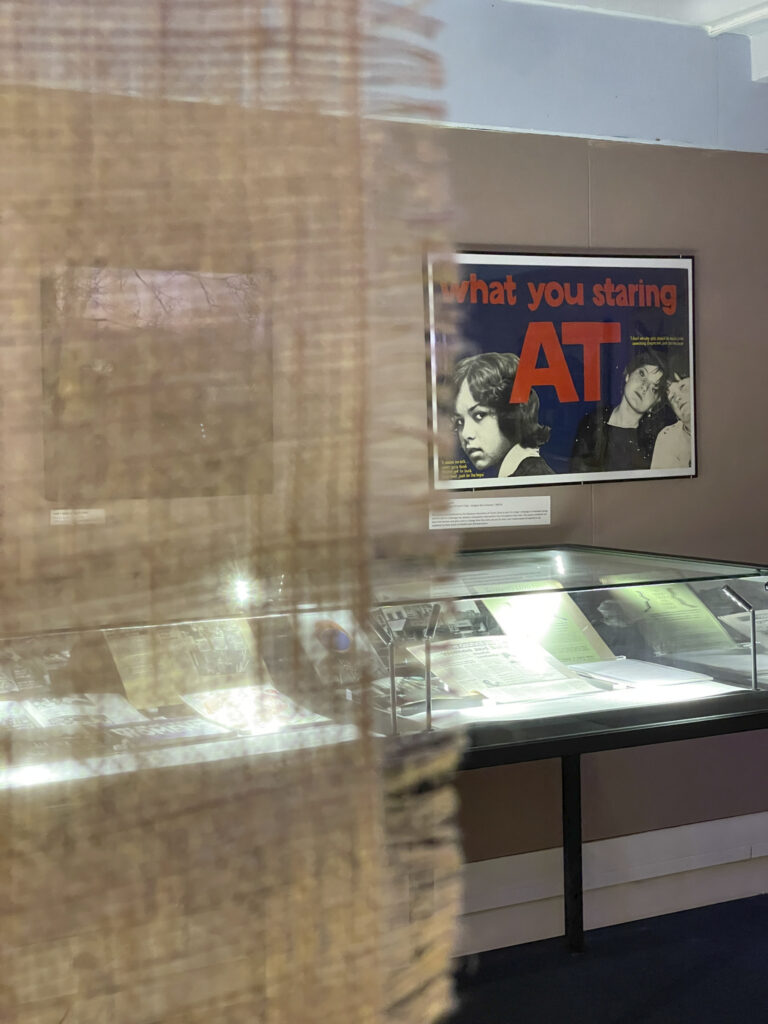
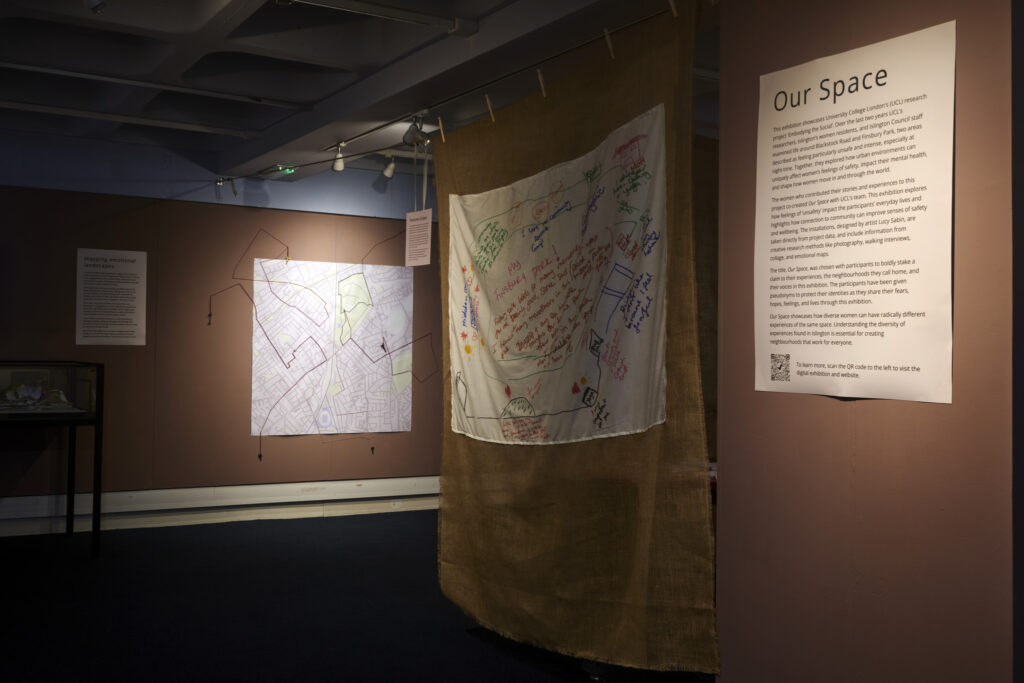
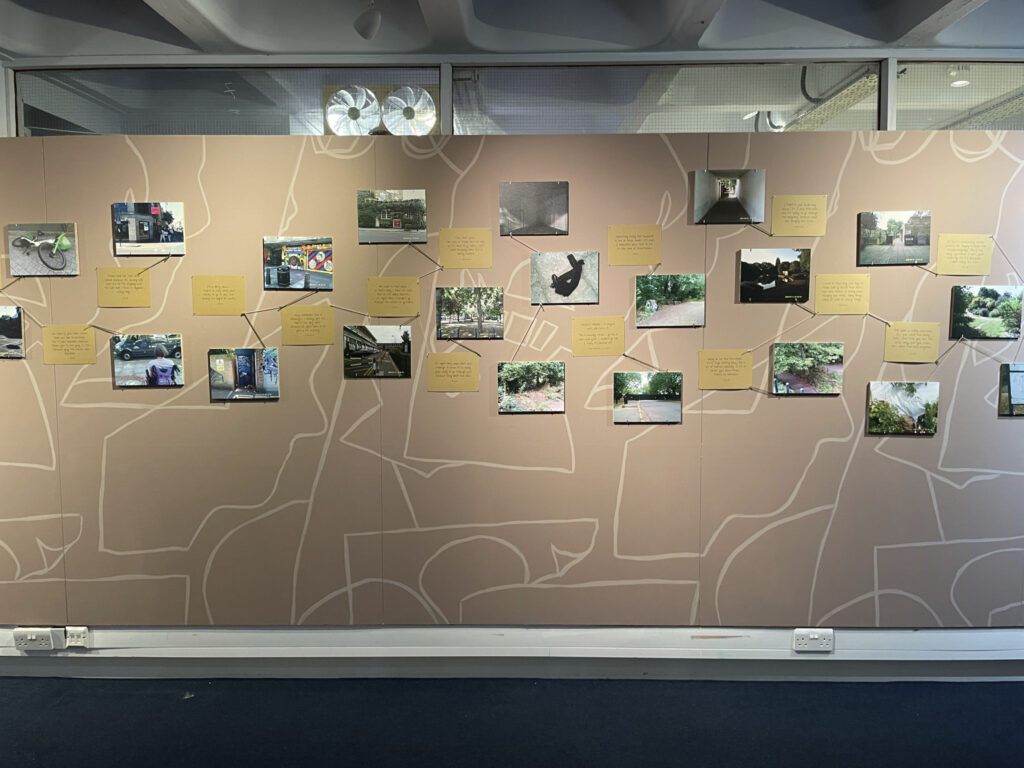
Images by Lucy Sabin and Denise Felkin. More images available here and on the exhibition website.
The exhibition aims to display the diversity of experiences found in Islington, an understanding of which is essential for creating neighbourhoods that work for everyone. Our Space reveals the many layers of place and ongoing inequalities that continue to shape how women navigate urban spaces, from access to green spaces and right to the city at night. The exhibition’s title was chosen with participants to boldly stake a claim to their experiences, the neighbourhoods they call home, and their voices in this exhibition.
Our Space highlighted the importance of community connection, and how it can improve everyday senses of safety and wellbeing. One visitor stated that the exhibition made them feel:
Very validated – sometimes you can’t put your finger on what makes you feel unsafe, you just know that you are! It’s reassuring to hear other women feel that way, and that there isn’t collective dismissal of this feeling.
Another added:
Seen & heard. Resonated so much! We need more anthropological research like this. Also it’s sad that the questions & discussions on women’s safety have been taking place for so long… I hope that one day we can wear whatever we like and walk safely to wherever we like. (Really enjoyed the documentary, so beautifully made!)
Why co-production matters
As a local authority museum, Islington Museum aims to not only reflect the realities of Islington life, past and present, but to contribute to a greener, safer Islington through exhibitions like ‘Our Space.’ This exhibition highlighted how local authority museums are uniquely placed to intersect with council priorities and leading academic research to raise greater public awareness of issues like VAWG and advocate for positive social changes. The co-productive aspect allowed for a plurality of expertise – artistic, academic, experiential, and curatorial. The resulting exhibition shared data through the artistic interpretation of participants and co-curator Lucy Sabin, allowing an accessible understanding of ‘Embodying the Social’ research project and provoking emotional, thoughtful, and actionable feedback for future project use.
For UCL researchers, working with Islington Museum has created a remarkable opportunity to showcase research through a timely, accessible, and creative output such as a community exhibition. This partnership has facilitated important conversations within communities about women’s safety and urban experiences, and made academic research readily available and comprehensible to the wider public and neighbourhood residents. The collaboration and the resulting exhibition have provided an opening and welcoming environment to engage not only council members, local government but also wider stakeholder communities such as the Metropolitan Police.
From research to impact
Our Space aims to start a wider conversation, bringing local communities, researchers, policy makers, and key stakeholders together to address urban issues and inequalities. This research and exhibition have been shared and discussed at length with Islington council Community Safety, Night-Time Economy, and VAWG teams through multiple knowledge exchange events. For example, Jimmy Flynn, Networks and Partnerships Manager at Islington Council states:
Engaging with UCL on this work has given us much deeper, qualitative insights than we’d ever have been able to gather on our own. It’s also led to follow-on funding bids and real, positive change. We’re lucky in Islington as there is so much expertise and resource in or near the borough – but sometimes residents and groups can get stuck or excluded from this. The relationship with UCL counters this – it builds new connections, widens perspectives and opens up possibilities. The research work and ‘Our Space’ exhibition is a perfect example of this – positive, creative, true and something that can lead to improvement and change in an area and in people’s lives.
In collaboration with Islington Faiths Forum led by Roz Miller, this research has also resulted in a significant policy intervention; the creation of the Women’s Safety Night Service (WSNS), funded by Cabinet Office’s Test Learn & Grow VAWG Accelerator and Islington Council. The WSNS includes 2 Parkguard patrol officers and a female paramedic who deliver this service as proactive pulse patrols for women’s safety every Friday evening in the Finsbury Park area from 7pm-3am. While evaluation of the WSNS is ongoing, preliminary feedback is overwhelmingly positive. The work shows what becomes possible when researchers, residents, the council and the museum come together. By combining academic insight, creative practice and local knowledge, the partnership has turned women’s experiences into something that can be seen, heard and help shape safer communities.
Explore Our Space exhibition online
 Join our mailing list