How We Did It: Bringing partnerships together across a place to support communities

How can public services break down silos and work hand-in-hand with communities to prevent problems before they start?
As part of our How We Did It series for New Local members, we sat down in conversation with Kirsty Wilkinson, Public Health Strategic Manager, Durham County Council, to explore how the County Durham Together Partnership was established and the lessons learned along the way, a compelling example of how co-producing solutions with communities can deliver striking returns.
The context
County Durham is home to rural and former coalfield communities, historic landmarks and beautiful North Sea coastline. It hosts Kynren, the largest outdoor show organized and performed by over 1,000 volunteers. The county has a strong history of partnership working, with especially strong relationships with the voluntary and community sector, whose ability to adapt and mobilise quickly during the pandemic showed these community strengths in action.
County Durham has an ageing population and, in this context, faces deep-rooted health inequalities, with those in areas of multiple disadvantage experiencing the worst outcomes. A recent survey found many people feel lonely and don’t feel involved in decisions about their lives. County Durham Together Partnership was born out of a desire to build on the county’s existing strengths, while responding to these challenges.
Durham County Council became a unitary authority in 2009 and, in May last year, became the first reform-led council in the UK.
The solution
County Durham Together brought together partners across a whole system and was built around the County Durham Approach to Wellbeing’s seven principles, which are using what works, being asset-focused, sharing decision-making, empowering communities, doing with them not to, building resilience and working better together. The partners developed a vision and a series of ambitions linked to the approach, including joining up data and intelligence, pooling resources and jointly commissioning where appropriate, identifying and maximising the impact of assets while reducing duplication, streamlining “step up and step down” support pathways, and streamlining community engagement so people are asked once about what matters to them rather than by every organisation separately.
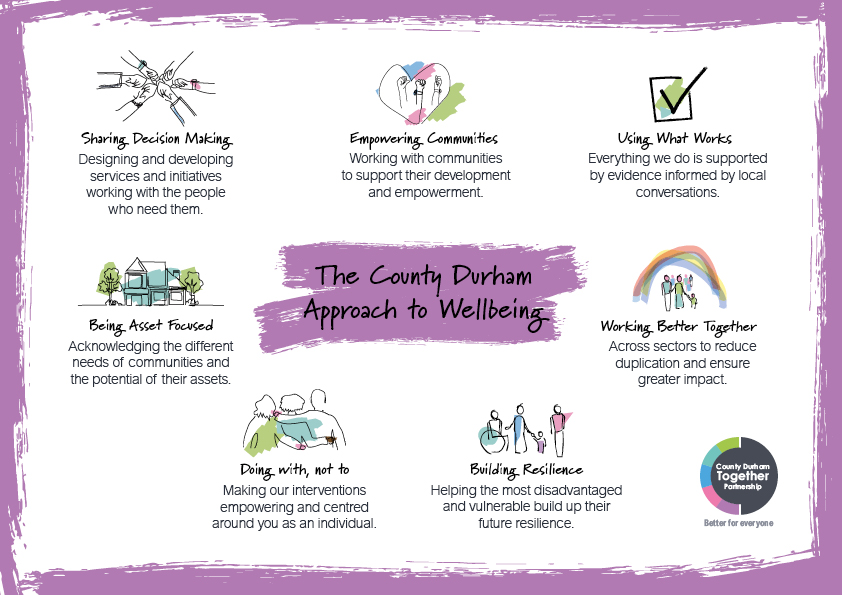
Partners worked through a series of workshops where people were pulled together to drill down into what the approach to wellbeing really means. There was a real desire to change the relationship with communities, giving them a more equal voice in decisions that affect them and greater say over the design of policy, services and initiatives. The partners are committed to moving from consultation and “tick box exercises” to co-producing outcomes with communities.
The partnership launched the Let’s Talk County Durham, a consultation and engagement platform which aims to reduce consultation fatigue. It provides the ability to see across consultations so that respondents are not asked the same questions over and over again.
The difference it made
The partners achieved several great outputs including:
- Connecting County Durham, a community directory providing up-to-date information about available services to support self-efficacy and early help.
- A co-production toolkit which has expanded into staff training and a “spectrum of involvement.”
- Durham Insight and the Durham Index of Need, a data platform pooling information to better understand community needs.
- A Joint Strategic Needs and Assets Assessment, which identifies strategic assets alongside community needs.
- REACH (Research and Evaluation Across Communities for Health), which supports communities to get involved in evaluation and research around public health priorities.
An example that shows the impact of these activities is the Horden Together Project. Horden is the most deprived area in County Durham. Where the work had been transactional previously, the team have developed a much more relational approach. A recent evaluation by Edinburgh University found that for every £1 invested, there is up to £28 return on investment, just by changing the way the work is done.
This points to the main impact of the partnership: it’s not about what they have done, but how they do it.
Changing the culture of how we do things takes quite a considerable length of time… I’m not saying we’ve got it cracked, because we haven’t. It’s just we’re on that journey at the moment.
What made it work
The strong history of partnership-working in County Durham, especially relationships with the voluntary and community sector that grew during the pandemic provided the foundation. Grounding the work in community-centred and asset-based approaches, and translating that into seven shared principles, gave the partners a common framework. Getting people into rooms together to genuinely thrash out issues, rather than one party dictating outcomes, was really helpful.
Challenges and the approach to navigate them
Changes in personnel across the partnership, including the chair, occurred all at once, alongside different levels of commitment across partners and questions about the added value of the board itself, prompted a desire for efficiency and fewer meetings. A review of the partnership also surfaced that partners were uncertain about the vision statement, felt it was overcomplicated, and were unclear on their individual and collective roles; there was no formal induction process, so turnover meant new people struggled to get up to speed; and there was a feeling the partnership lacked the authority and confidence to move things forward at pace, worsened by partners sending deputies. To address this, Durham worked with New Local to bring an independent view, running interviews with members and workshops where members could contribute to shaping the partnership’s future. This was a genuinely collaborative process offering options to stop, continue, or adapt.
What others can learn from the process
One of the biggest things for the partnership is supporting people to understand that people don’t live in policy silos.
County Durham Together created a connecting space to look across organisational boundaries and move beyond silos, shifting the partnership’s core focus away from consultation and tick-box exercises, toward genuinely co-producing outcomes with communities. Evidence from Horden Together proves that these approaches work.
That said, “one of the biggest challenges is really balancing the long-term prevention with short-term financial pressures. Across many, many systems, and I’m sure everybody feels this, we’re seeking increased demand for specialist and high-cost services at the same time as our budgets are reducing. And quite often, the prevention and community capacity building, whilst they’re the right thing to do, the benefits aren’t necessarily realized, particularly within single budget cycles.”
“The challenge for system leaders is creating enough space to invest in longer-term change and prevention whilst managing immediate operational and financial pressures.”
What’s next?
The Board agreed to merge the system leadership side with the County Durham Partnership while subgroup work continues, though governance currently “feels a bit stuck” as that partnership is undergoing its own review. Kirsty hopes County Durham Together can bring together the growing number of smaller place-based initiatives (Neighbourhood Health, Neighbourhood Mental Health, Pride in Place, Community Resilience Programme, etc.) under its high-level governance. The broader ambition is to organise systems around people’s lives rather than individual programmes, since communities don’t experience life in policy silos.
Cover photo by Jeffrey Zhang on Unsplash.
 Join our mailing list