Reimagining commissioning: towards relational, learning-centred approaches
Commissioning is the primary gateway between policymakers setting priorities and the organisations delivering them, translating policy ambition and public resources into practice on the ground.
Yet too often commissioning is characterised by transactional approaches. It is driven by managing risk rather than building relationships, by assuring delivery against predefined performance indicators rather than enabling learning across a system. In doing so, it can make it harder to develop the cross-sector collaborations needed to build on communities’ strengths and respond to the increasingly complex challenges places face.
Commissioners operate in environments of continual pressure, balancing competing priorities, responding to diverse and changing local needs, making difficult decisions about scarce resources, and demonstrating value for money to elected members and central government. Against a backdrop of constrained public finances, it is understandable that commissioning processes are often primarily designed to provide assurance and reduce immediate financial and political risk. But while these approaches may help manage short-term uncertainty, they struggle to create the conditions needed for the long-term, preventative and place-based ambitions at the heart of today’s public service reform.
Imagining a new approach
The Cabinet Office’s Test, Learn and Grow (TLG) programme is central to the UK Government’s ambition to drive innovation and reform in public services. Partnering with local government and working alongside citizens and civic society, the programme supports places to design and test new approaches to public service delivery. The aim is to improve outcomes for communities, whilst ‘growing’ the conditions in the system that make this way of working possible.
It is therefore no surprise that commissioning has emerged as a key theme in TLG’s engagement, as an important ‘system enabler’ for the kind of relational, collaborative and learning-centred ways of working the programme is working to support across central government, local government, cross-sector partners and communities.
In conversations with senior leaders, practitioners and commissioners from across the public sector, commissioning repeatedly surfaced as both a frustration and an opportunity. People described feeling constrained by rigid processes and short-term incentives, while at the same time expressing passion and optimism for doing things differently.
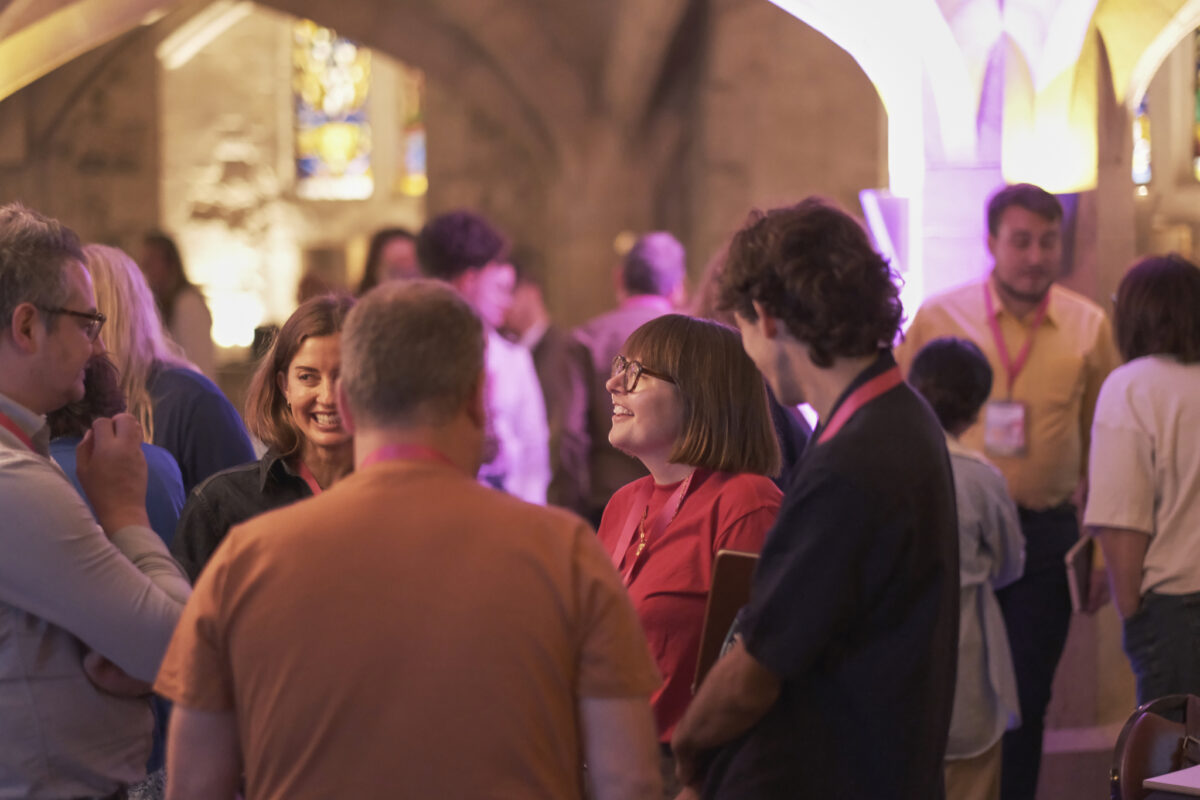
New Local’s Stronger Things provided an opportunity to explore these ideas collectively. Working together, the TLG team and New Local invited participants into the Guildhall crypt to respond creatively to a simple question:
What would commissioning look like in a future that genuinely centres relational, collaborative and place-based ways of working?
Three themes emerged consistently illustrating the kind of future that was being painted by participants in the room.
Relationships as the core ingredient
The point that Sir David Robinson, founder of the Relationship Project, made so eloquently in his Stronger Things opening keynote resonated throughout the workshop: relationships are both the means and the outcome. They are not simply a soft add-on, but the infrastructure that enables public services to collaborate, adapt and improve over time.
In this future, commissioning moves beyond episodic interactions such as procurement exercises, contract management meetings and performance reporting, and towards ongoing relationships characterised by trust, reciprocity and shared understanding. Rather than attempting to eliminate uncertainty through increasingly detailed specifications, uncertainty is better managed through strong relationships that allow people to solve problems and adapt together.
That shift starts with communities themselves by recognising the relationships, aspirations and strengths that already exist within a place. Effective commissioning builds on these assets, creating the conditions for communities to shape their own futures rather than simply being recipients of programmes and interventions.
Relational commissioning also reshapes how VCFSE (voluntary, community, faith and social enterprise sector) organisations interact with commissioners. Rather than doing so primarily through contracts and performance management, they work in the open and build genuine partnerships. These trusted relationships enable honest conversations when things inevitably become difficult and recognise local knowledge as an essential form of expertise. Working in these ways has the potential to unlock the VCFSE’s unique role as bridge-builders between public institutions and communities: convening people, listening deeply, adapting as needs change and bringing lived experience into the design and delivery of services.
The role of commissioners also looks different. Rather than anticipating every possible circumstance through increasingly detailed contracts, commissioners work closely with organisations that share a common purpose and can be trusted to exercise judgement in changing circumstances. They step away from a role primarily concerned with controlling delivery, towards one focused on creating the conditions for shared decision-making.
For these relationships to flourish, participants agreed that the shift also needs to happen at the interface between central and local government. Rather than defining success through tightly prescribed outcomes and detailed performance management, central government sets a clear purpose while trusting places to determine how best to achieve it. In doing so, it creates the space for strong relationships to develop across the system, recognising that success comes not from eliminating uncertainty, but from enabling organisations to respond to it together.
Learning as a collective practice
If relationships provide the foundation, learning becomes the mechanism through which commissioning continually responds to changing needs, opportunities and challenges. Rather than assuming the right solution is known from day one, commissioning creates the conditions for experimentation, continuous feedback and adaptation as new insights emerge.
Participants described a future where learning is not something reserved for the end of a contract through evaluation. It becomes part of the fabric of commissioning itself. Evidence surfaces through practice, is explored collaboratively across partners and continually shapes future decisions.
For this to work effectively, knowledge does not sit solely with commissioners or evaluators. Communities, VCFSE organisations, councils and central government each contribute different forms of expertise, and better outcomes emerge when these perspectives are deliberately brought together. This elevates the value of rich qualitative insight gathered close to communities, recognising that smaller providers are often best placed to understand changing experiences and needs if they are given the time and resource to do so properly.
Participants reflected that centring learning as a shared practice would also require a significant shift in the role of central government. Rather than specifying solutions and managing performance from the centre, central government becomes a convenor of learning across the whole system: encouraging experimentation, building capability, connecting places to learn from one another and ensuring that local insight continuously informs national policy. Learning is not simply a means of improving delivery; it becomes an outcome in its own right.
Sharing power, risk and accountability
Running beneath all of this is a fundamental rethink of how power, risk and accountability are distributed across the system.
In the future that emerged through these discussions, no single organisation is expected to hold all the answers from the outset. If relationships and learning become central to commissioning, then power must also become more distributed. Communities move from being recipients of services to becoming partners in shaping them. VCFSE organisations become trusted collaborators rather than contracted providers. Local government becomes an enabler and steward of place. Central government shifts from specifying solutions to setting purpose, investing in capability and creating the conditions for local innovation and adaptation.
Perhaps most importantly, this challenges the assumption that risk can and should simply be managed away. Whereas traditionally risk is pushed down the system through tighter contracts and increased assurance, relational, learning-centred commissioning allows for responsibility for navigating risk to be shared collectively. Accountability remains grounded in shared purpose, trust and collective stewardship rather than compliance alone.
Glimpses of this future in the here and now
Across the country, there are places who are already demonstrating what more relational, learning-centred commissioning can look like.
In West Yorkshire, the Kirklees Better Outcomes Partnership (KBOP) brought together partners – including Home Group, Horton Housing, and Women Centre – under a single alliance contract supporting adults experiencing homelessness, poor mental health, substance misuse and unemployment. Rather than competing for service users or delivering against tightly prescribed activities, organisations are encouraged to collaborate around people’s wider needs, with flexibility to adapt support as circumstances change.
Or take the Plymouth Alliance for Complex Needs, which arrived at a similar destination by a different route. Rather than relying on traditional commissioner-provider relationships, Plymouth established a shared governance model in which the chief executives of seven provider organisations sit alongside three council commissioners as equal members of an Alliance Leadership Team, making decisions collectively and taking shared responsibility for outcomes and risk. It took four years of listening, relationship-building and developing a shared purpose before partners felt ready to formalise those arrangements. As Plymouth’s own reflections make clear, listening was not simply part of the process; it was one of the most important drivers of change, building the empathy and trust on which a genuinely shared model of governance could be built.
Where next?
Encouragingly, this direction of travel is not confined to local innovation. Many of the same themes are beginning to appear in national thinking. The Government’s publication on Rewiring the State points towards a more enabling role for central government, greater power and responsibility for places, and a state that is better able to learn, adapt and respond to complexity.
Perhaps this suggests that the challenge is no longer agreeing what good commissioning looks like. As the outlines are becoming clearer, the question is shifting towards what it takes to build on what is already strong, and how to enable these approaches to happen at scale. This challenge – the ‘Grow’ of Test, Learn and Grow – is where the greatest opportunities lie for driving lasting, system-wide improvements.
Success means paying greater attention to the how: the mindsets and values, capabilities, incentives and enabling conditions that allow relational, learning-centred commissioning not simply to emerge in exceptional places, but to become the standard way public services work.
 Join our mailing list